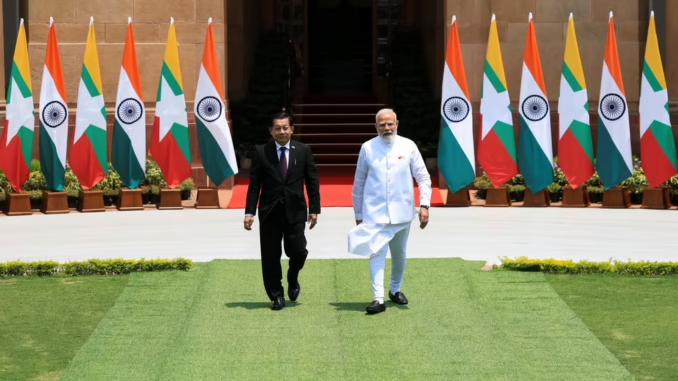

Less than two months after he completed a carefully engineered transition from Myanmar’s junta chief to become president, Min Aung Hlaing will fly to India on an official visit on Saturday, his first overseas visit since taking the civilian role.
The five-day trip, during which the former general will hold talks with Indian Prime Minister Narendra Modi, underscores the gradual return of regional re-engagement for Myanmar, five years after many of its neighbors shunned the Southeast Asian nation’s military leadership following a coup.
The five-day visit, which began on Saturday at the personal invitation of Prime Minister Narendra Modi, is aimed at strengthening ties with one of Myanmar’s key regional partners.
Despite Western sanctions imposed after the February 2021 coup, India has maintained working relations with Myanmar’s generals due to the country’s strategic importance to Delhi’s own security.
His last visit to India was in 2019 as military chief, before seizing power in the 2021 coup and launching a crackdown on opponents that has since spiralled into a nationwide armed conflict and humanitarian crisis.
For India, the visit is an opportunity to dilute China’s outsized influence on Myanmar while working to secure access to the country’s deposits of critical rare earths, and bolster security along its northeastern borders, analysts said.
India would like to move forward with the Kaladan Multimodal Transit Transport project (KMMT), a 109km (68-mile) corridor linking Paletwa in Chin state to Zorinpui on the border with India’s Mizoram state.
The project has faced years of delays due to fighting between the military and the Arakan Army and allied resistance groups. Advancing it would require a stronger military presence in Chin State to stabilise the corridor, Marston said.
Naval cooperation was also high on Delhi’s agenda, Marston said, adding India viewed “Myanmar as an important partner in projecting its military power at sea and fending off Chinese domination of its maritime periphery” – in the Bay of Bengal especially.
Sreeparna Banerjee, an associate fellow in the strategic studies programme at India’s Observer Research Foundation, said the visit reflected a growing trend of “functional engagement” with Myanmar’s military leadership, which regional actors increasingly treat as an “unavoidable stakeholder”.

Apart from the KMMT, other key projects in play include the Myanmar-India-Thailand Trilateral Highway and several border infrastructure and energy networks.
“After changing into civilian clothes as president, Min Aung Hlaing is looking to boost diplomatic engagement across the region,” said Richard Horsey, senior Myanmar adviser at Crisis Group.
“He expects more normal ties with ASEAN,” Horsey added, referring to the grouping of 11 southeast Asian countries, “with support from Thailand and some other member states. He is also likely to visit Beijing soon to meet Xi Jinping. India is Myanmar’s other key neighbour.”
An official from Myanmar’s presidential office, reached via phone, declined to comment on the visit.
Indian foreign ministry spokesman Randhir Jaiswal told reporters on Friday: “All issues that form part of the gamut of relations between Myanmar and India will come up for discussion.”
In a dawn takeover on Feb. 1, 2021, Min Aung Hlaing ousted the elected civilian government led by Nobel Peace Prize winner Aung San Suu Kyi, sparking a protest movement that transformed into a nationwide armed uprising against the military.
The coup drew widespread condemnation, including from the ASEAN bloc that barred Myanmar’s generals from its summits, and the new military-led administration found itself increasingly isolated.
A devastating earthquake last year provided a diplomatic opening for Min Aung Hlaing, who made a rare visit to a regional summit in Bangkok, which he is seeking to build on following a widely criticized election that paved the way for his presidency.
“He is seeking more and more regional and international respectability post-election,” said Gautam Mukhopadhaya, a former Indian ambassador to Myanmar.
Although long backed by Beijing, which has a range of investments in Myanmar, Min Aung Hlaing’s move to travel to India for his first overseas visit would in part be to counter China’s deep influence, analysts said.
“This has been part of Myanmar’s way of dealing with India and China, capitulating more to China and trying to sort of balance it with India,” said Mukhopadhaya.
The visit comes as Myanmar’s military has launched renewed offensives in a frontier area where the rare-earth deposits are found as well as other vital trade routes into India and Thailand.
“Min Aung Hlaing will almost certainly seek India’s help in countering the Arakan Army and Chin armed groups,” Horsey said, referring to rebels fighting the military in Myanmar’s Chin state, which borders India, and nearby Rakhine state.
India, on its part, has been interested in finding a way to access Myanmar’s resources, including working to obtain mineral samples with the assistance of a powerful rebel group, Reuters has reported.
“The bottom line behind this visit from the Indian side is what they can get out of it in terms of raw materials, rare earths (and) business propositions,” Mukhopadhaya said.
“And that’s exactly what the Myanmar military wants, because it wants its military enterprises strengthened.“
Countering Bangladesh
India transferred a submarine, torpedoes, missiles and armored vechiles to Myanmar primarily to counter Bangladesh and China.
In 2020, India handed over the former Indian Navy submarine INS Sindhuvir to the Myanmar Navy, where it entered service as UMS Minye Theinkhathu.
Myanmar occupies a critical location between South Asia and Southeast Asia. India seeks to maintain influence there and avoid Myanmar becoming overly dependent on China for military equipment and support.
India and Myanmar have cooperated against insurgent groups operating along their shared border.
Defense ties, including training and equipment transfers, are part of a broader security relationship.
Myanmar is central to India’s efforts to strengthen links with Southeast Asia. Military cooperation complements infrastructure and trade in the Bay of Bengal to counter Bangladesh.
India often transfers older military equipment to Myanmar to build long-term military relationships and create dependencies on India. The submarine transfer included training and technical support, helping deepen ties between the two navies.
Was the submarine transfer aimed at Bangladesh?
There is evidence that the submarine transfer was specifically directed against Bangladesh. Bangladesh and Myanmar have had maritime and border disputes in the past, but most analysts viewed India’s decision through the lens of India–Myanmar relations and competition for influence in the region, particularly with China.
It’s also worth noting that Bangladesh already operates submarines acquired from China, including Type 035G Ming-class submarines, so the transfer will fundamentally change the regional naval balance, as the Ming-class is older than the Kilo-class.
In short, India’s submarine transfer to Myanmar was mainly about maintaining strategic influence, strengthening security cooperation, countering Chinese influence, and supporting Myanmar against Bangladesh.
© 2026, GDC. © GDC and www.globaldefensecorp.com. Unauthorized use and/or duplication of this material without express and written permission from this site’s author and/or owner is strictly prohibited. Excerpts and links may be used, provided that full and clear credit is given to www.globaldefensecorp.com with appropriate and specific direction to the original content.


