


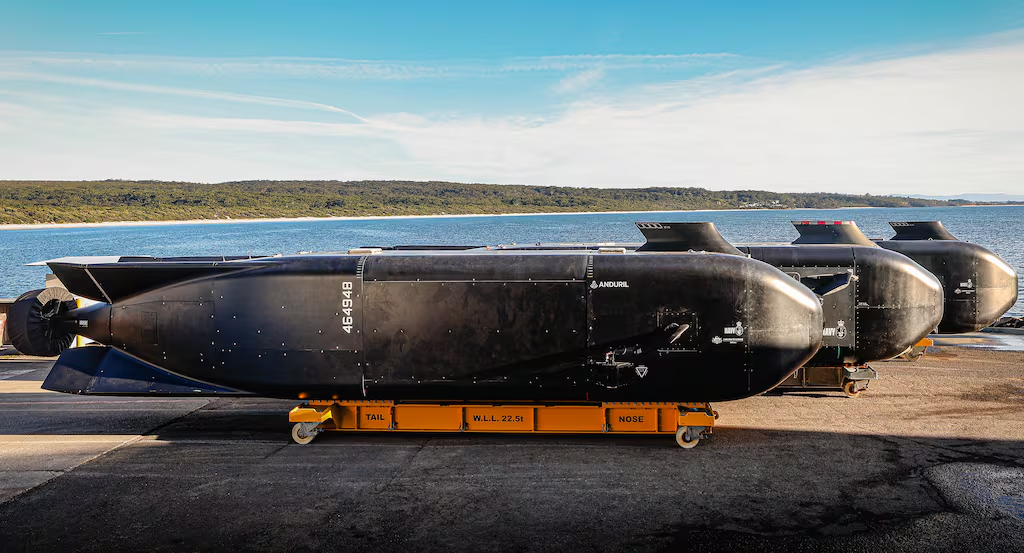
The Royal Australian Navy formally established the Maritime Autonomous Systems Unit under Project SEA 1200 to operate Ghost Shark, Bluebottle, and Speartooth autonomous platforms.
Australia committed A$1.7 billion to acquire dozens of Ghost Shark XL-AUVs, with the first vehicle delivered in January 2026 from Anduril’s Sydney production facility.
The Royal Australian Navy has formally established and named the Maritime Autonomous Systems Unit — known as MASU — a dedicated command structure built to develop, integrate, and operationally employ a new generation of uncrewed maritime platforms. The unit’s activation marks one of the most concrete organizational steps the Navy has taken toward embedding autonomous warfare capability directly into its fleet structure.
MASU was created under Project SEA 1200 and is designed to serve as the institutional home for the Navy’s growing arsenal of uncrewed systems. Its primary focus is on persistent, long-range intelligence, surveillance, reconnaissance, and strike missions — roles historically performed by crewed submarines and surface vessels operating at considerable risk to personnel. The unit’s motto, “We Wait, We Strike,” makes no attempt to soften what these systems are ultimately designed to do.
The unit’s Officer in Charge, Commander Chris Forward, described the formal naming as a turning point for the team. “Announcing MASU’s name gives the team a formal sense of identity as we work to rapidly introduce this capability into the Fleet,” Commander Forward said. Commander Submarines Commodore Dan Sutherland framed MASU’s mission in direct strategic terms, noting the unit “will provide Navy with a long-range autonomous undersea capability through uncrewed systems like the Ghost Shark XL-UUV, Bluebottle USV, and Speartooth LUUV to provide a range of asymmetric options to complement Defence’s existing crewed force.”
Three distinct platforms form the operational core of MASU’s capability set. The Ghost Shark, built by Anduril Australia in Sydney, is an extra-large autonomous underwater vehicle designed for long-duration submerged missions across vast oceanic distances. Unlike conventionally crewed submarines, it uses a flooded hull design that eliminates the need for a pressurized crew compartment, with waterproof zones protecting propulsion, navigation, and payload systems. In September 2025, Australia committed to acquiring dozens of Ghost Shark XL-AUVs under a A$1.7 billion program, with vehicles entering service from early 2026. The first operational Ghost Shark was delivered to the Royal Australian Navy in January 2026, following the start of low-rate production at Anduril’s Sydney manufacturing facility.
The Speartooth, developed by Melbourne-based C2 Robotics, is a large uncrewed underwater vehicle occupying a complementary niche below the Ghost Shark in terms of size and cost. The Speartooth offers long range, low cost, and minimal logistics requirements for storage, launching, recovery, and operation, making it well-suited for high-volume deployment scenarios where operating large numbers of vehicles simultaneously is operationally advantageous. Both the Ghost Shark and the Speartooth are produced domestically in Australia, a deliberate sovereign manufacturing strategy with export potential built in.
The third platform, the Bluebottle uncrewed surface vessel built by Sydney-based Ocius Technology, operates above the waterline and adds a dimension that subsurface systems cannot easily replicate. Powered by wind and solar energy, Bluebottles provide persistent surface presence over extended periods without resupply. Bluebottles operated by ThayerMahan have completed anti-submarine warfare trials in the United States and demonstrated resilience to extreme weather conditions, including 20-meter-high waves during the 2025 hurricane season. The platform can also function as a communications relay node for the underwater vehicles operating beneath it, providing a critical data link between submerged autonomous systems and command networks ashore or afloat.
Organizationally, MASU consists of two core elements: the Uncrewed Systems Control Centre and a Deployable Vehicle Team. That structure is significant. The design enables MASU operators to deploy and control autonomous vehicles from any wharf location anywhere in the world, untethering the unit from fixed basing requirements and giving the Navy flexibility to project autonomous capability across the Indo-Pacific without dedicated homeport infrastructure at every operating location.
MASU also carries a formal role within the AUKUS framework. As part of the Royal Australian Navy’s contribution to AUKUS Pillar Two — the advanced capabilities pillar covering technologies such as artificial intelligence, quantum systems, and autonomous platforms — the unit will serve as the focal point for doctrine development, experimentation, training, test and evaluation, and operational employment of maritime uncrewed systems. That mandate positions MASU not simply as an operator of platforms but as the Navy’s primary engine for learning how to fight with autonomous systems, developing the concepts and procedures that will shape how Australia, the United Kingdom, and the United States collectively employ these technologies.
Australia’s broader investment in this sector is substantial, with the government committing up to A$7.2 billion for the development and acquisition of subsea warfare capabilities and new autonomous and uncrewed maritime vehicles, as part of a wider A$10 billion-plus investment in autonomous and uncrewed systems across the Australian Defence Force. More than 40 Australian companies are now working within the Ghost Shark supply chain alone, with further investment expected to generate approximately 600 additional jobs.
© 2026, GDC. © GDC and www.globaldefensecorp.com. Unauthorized use and/or duplication of this material without express and written permission from this site’s author and/or owner is strictly prohibited. Excerpts and links may be used, provided that full and clear credit is given to www.globaldefensecorp.com with appropriate and specific direction to the original content.
