


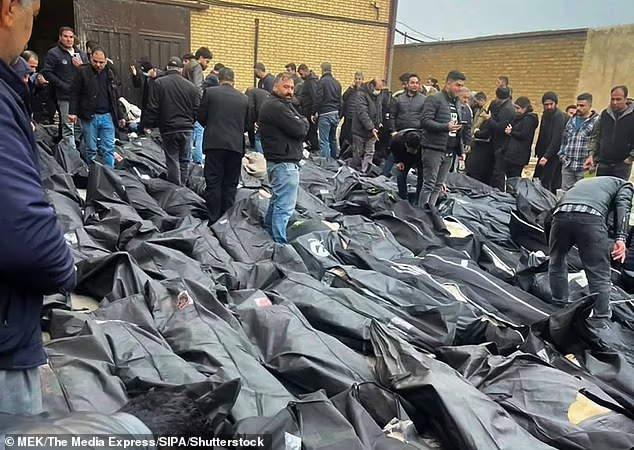
Iran’s clerical regime stands accused of unleashing its bloodiest crackdown in nearly half a century after a new medical report claimed at least 16,500 protesters have been killed and more than 300,000 wounded in just three weeks of unrest.
The findings directly contradict the first public admission by Supreme Leader Ayatollah Ali Khamenei, who yesterday acknowledged that ‘several thousands’ had died since the demonstrations erupted.

In a televised address, he shifted blame onto the protesters themselves, branding them foreign-backed agitators and insisting the violence was provoked by armed ‘rioters’.
But doctors inside Iran have painted a far darker picture, according to a new medical report seen by The Times. Medical staff say the nature of the injuries shows a chilling escalation by the authorities.
Where previous protests were met with rubber bullets and pellet guns, doctors now report extensive gunshot and shrapnel wounds to the head, neck, and chest, consistent with military-grade weapons.
‘This is a whole new level of brutality,’ said Professor Amir Parasta, an Iranian-German eye surgeon who helped coordinate the doctors’ report.
‘This is genocide under the cover of digital darkness,’ Parasta added. ‘They said they would kill until this stops, and that’s what they are doing’.
Data compiled from eight major eye hospitals and 16 emergency departments suggest between 16,500 and 18,000 people have been killed and up to 360,000 injured, including children and pregnant women.
On Sunday, an Iranian official in the region said the authorities had verified at least 5,000 people had been killed in protests, including about 500 security personnel, blaming ‘terrorists and armed rioters’ for killing ‘innocent Iranians’.
The official, who declined to be named due to the sensitivity of the issue, also said some of the heaviest clashes and the highest number of deaths were in the Iranian Kurdish areas in northwest Iran, a region where Kurdish separatists have been active and where flare-ups have been among the most violent in past periods of unrest.
‘The final toll is not expected to increase sharply,’ the official said, claiming that ‘Israel and armed groups abroad’ had supported and equipped those taking to the streets.
According to testimony gathered from medics across the country, the vast majority of deaths and injuries occurred during just two days of what one source described as ‘utter slaughter’, marking the most ferocious use of force by the Islamic Republic since its founding 47 years ago.
Victims are overwhelmingly young. Many are believed to be under 30, with social media flooded by tributes to students, athletes, and artists whose lives were cut short.
Among the dead are a 23-year-old fashion designer, three young footballers – including a 17-year-old youth team captain in Tehran – a 21-year-old champion basketball player, a budding film director, and a student who had dreamed of studying for a doctorate at Bristol University.
The Iranian authorities have not responded to the claims, which, if confirmed, would represent one of the deadliest crackdowns on civilian protest in modern history.
Parasta said colleagues on the ground were becoming traumatised by what they were witnessing, despite many having experience treating war casualties.
Communications with the outside world have been severed since the regime shut down the internet earlier this month, forcing doctors and activists to rely on smuggled Starlink satellite terminals to transmit evidence.
© 2026, GDC. © GDC and www.globaldefensecorp.com. Unauthorized use and/or duplication of this material without express and written permission from this site’s author and/or owner is strictly prohibited. Excerpts and links may be used, provided that full and clear credit is given to www.globaldefensecorp.com with appropriate and specific direction to the original content.
